

People don’t follow titles, they follow leaders who care about their success. Having the role of Manager, Director, or CEO doesn’t make someone a leader people will follow. The traits and characteristics that allow them to inspire and motivate people towards common goals are what makes them a leader.
A Partner from the company I worked for once said, “You’re good at strategy, coming up with ideas, and solving problems. We just need to get people to follow you.” I lacked the key attributes of leadership, which held me back in my corporate career. I knew that to succeed at the level I wanted to, and to build amazing and empowered teams, my title was not enough.
According to Forbes, 98% of people with managerial titles feel that they need more training. It’s good news. You can learn leadership traits!
As a coach, I’ve studied exceptional leaders and people to bring you the five perfected practices of the world’s greatest leaders.
Become an exceptional active listener.
Active listening is taking in the information without listening simply to respond. You cannot mind-read so you need to give your team a platform to give feedback. Communication and listening are key to knowing what is going on with your team. Ask what their goals and motivators are, and encourage honest feedback on how you as a leader can evolve and improve. Be fully transparent with your team, and you will get the same in return.
Foster and show empathy.
People care about leaders who care about them. Our teams are people with lives, emotions, struggles, and dreams. We should treat them as such, acknowledging their feelings and ideas. As leaders, we should know the demands on our team and how it impacts their work-life balance. We do not have two lives, the personal and professional are intertwined.
Recognise great work.
Make time to commend your team when they do something well. Positive reinforcement really works! Giving your team the credit they deserve is one of the biggest indicators of leadership effectiveness, as shown in the research from the Zenger Folkman assessments of over 3,800 leaders.
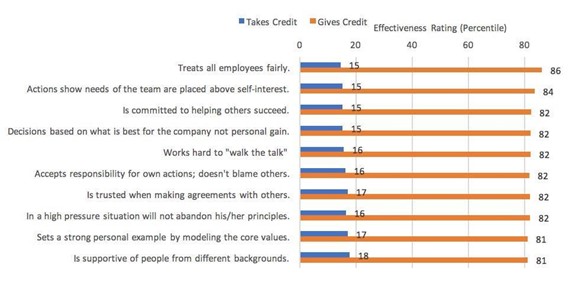
Source: Leader Effectiveness ZFCO
Run with the troops.
Great leaders don’t sit in a glass office a floor away from their team. Jack Dorsey, the Co-Founder and CEO of Twitter, had his desk in the middle of the office. He encouraged people to interrupt him anytime for questions. Whilst not conducive to deep work, it showed he always had time for them. If the workload is getting heavy, chip in.
Gratitude goes a long way.
Your team is there to support you. Be grateful for the work that they do. Small acts add up like remembering birthdays, ordering in if it’s going to be a late one, and doing the breakfast run. If your team is staying late, stay with them. Order dinner to the office and work out how they can get that free time back.
Lead by example.
Don’t expect others to do things you don’t. Embody the right kind of qualities you want to see in your team. If a challenge arises, show them your resilience and solve the problem together. Give out a positive emotional signal as moods are as contagious as the common cold. You can feel uplifted by walking into a room of others who are full of enthusiasm. The Founder of Patagonia gave his shares to a climate crisis fund. He also paid his team to take leave and fight for those causes. Yvon Chouinard led by an excellent example.
Empower those around you.
Training and development are essential for anyone to do their job well. Cultures of continuous learning are what make the most innovative organisations and motivated teams. Give them the guidance and resources they need to succeed. Winston Churchill – showed that real leaders take risks, set the tone through actions, and inspire others to succeed. To be a good leader, you must always keep learning, genuinely care about your team, and show commitment to their growth and well-being.
Trust your people.
When people feel trusted, they’ll start trusting you and grow the confidence to bring more to the table. Walt Disney created a successful empire worth billions by letting experts make decisions. You have hired people for a reason, let them do their job and work through upskilling together.
It is not merely about holding a leadership title but about earning respect and fostering a dedicated team. By becoming a great leader, you contribute to the creation of a positive and empowering organisational culture.