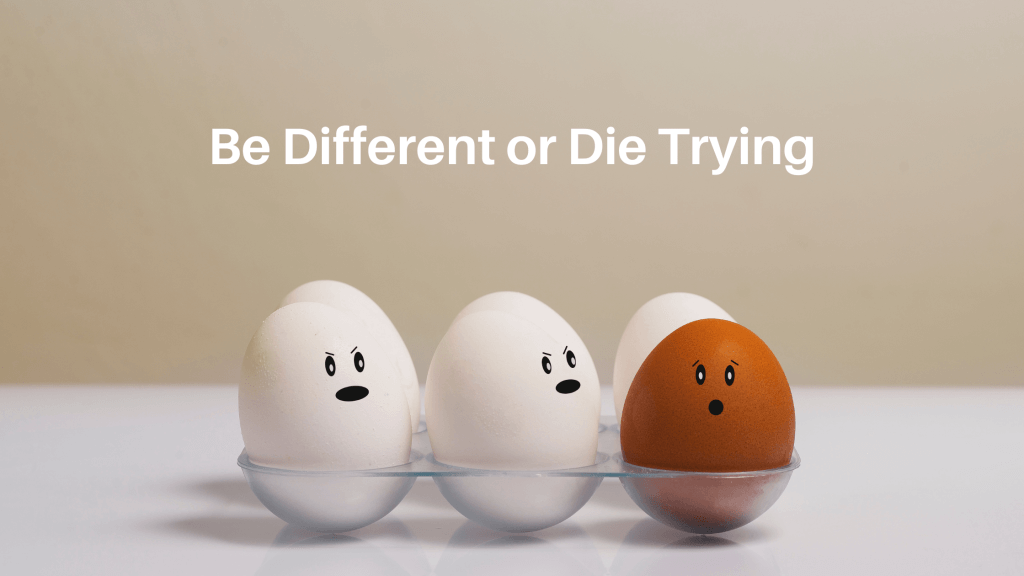
Different: (adjective) not the same as another or each other; unlike in nature, form, or quality.
To conform or not to conform
Many of us grew up in times where if you didn’t fit the ‘norm’ there was something wrong with you. In some cultures, being too far from what is considered normal is grounds for being shunned by society or could even be a criminal offence, granting you less human rights because you don’t fit the script that’s been written decades before.
I remember as a young child asking too many of the ‘wrong questions’, exhausting my father by not fitting expectations of what I should be curious about.
Conformity has evolutionary advantages, being part of the pack meant inclusion in hunter-gatherer mealtimes when food is scarce and a spot in the communal cave. However, in today’s society we no longer need to conform as a means of survival.
The courage to be different is the courage to be disliked
Showing your difference takes courage, it creates risk. Different thinkers make people uncomfortable! We are instinctively drawn to those who look, act, dress, talk and are like ourselves. Being too unusual poses the risk of being disliked and therefore rejected and misunderstood by those around us.
“The courage to be happy also includes the courage to be disliked. When you have gained that courage, your interpersonal relationships will all at once change into things of lightness.” – Ichiro Kishimi in The Courage to Be Disliked.
What this means for businesses:
Many organisations look for unique candidates to take them in new and exciting directions. We hire leaders we believe will take a fresh perspective on old problems. However, once in the role they’re expected to conform and comply with the company culture.
People that have been at organisations a long time are often doing things the same way they have been for years. Just because a process has been done for years doesn’t mean there isn’t a better way. Change can be intimidating and facilitating organisational change can be met with resistance.
Why does it matter?
If following the crowd means we can fit in and be accepted into the clan, why would we ever try to be unique?
Change is happening fast, every single minute 695,000 Instagram stories are shared, 21.1 million text messages are sent, $1.6 million is spent online and 5,000 TikTok downloads are made. There is a bigger competition for our attention than ever before. Our screen time and clicks are going to the highest bidder, our spend with the clearest messenger and we’re dealing with so many non-traditional competitors.
The playing field has been irreversibly changed, it’s no longer good enough to just produce a good product or service but it needs to stand out for all the right reasons. In a world of so many choices (over 1,000 ice cream flavours exist), being different means being noticed.
The bottom line is that organisations need to be distinct. If everyone is looking to their competitors for their next move, then no progress will ever be made. You may get much better, but you will never be different.
How to embrace your difference
In life and business, differentiation starts with you.
-
Become your authentic self.
Question things in your life and business. Don’t accept that just because something has always been done a certain way that it’s the best and needs to continue. What aspects of yourself and your beliefs are you hiding behind a complicated charade? What limiting beliefs are you holding onto?
-
Put yourself in the shoes of others.
Whether that’s your clients, the people that surround you. Focus on how they experience you in this world. Everyone is effectively competing to get noticed, what are you noticed for? Can you find a unique solution to a problem?
-
Drill down to what you’re great at.
Everyone has got a speciality or a field, task, instrument or topic they have mastery above the level of the average person in. What do you really want to be? Can you niche and get so good that you own and dominate that niche? Now that’s standing out for being different for the right reasons.
There are 7.8 billion people on the planet, each with up to 60,000 thoughts per day which is 468,000,000,000,000 thoughts. 95% of these thoughts are repetitions from the day before. We need different thinkers in business to cut through the 10,000 ads each person is exposed to daily, cutting through the noise and finding innovative future-oriented solutions.
The competitive advantage is difference, in both you and your organisation.